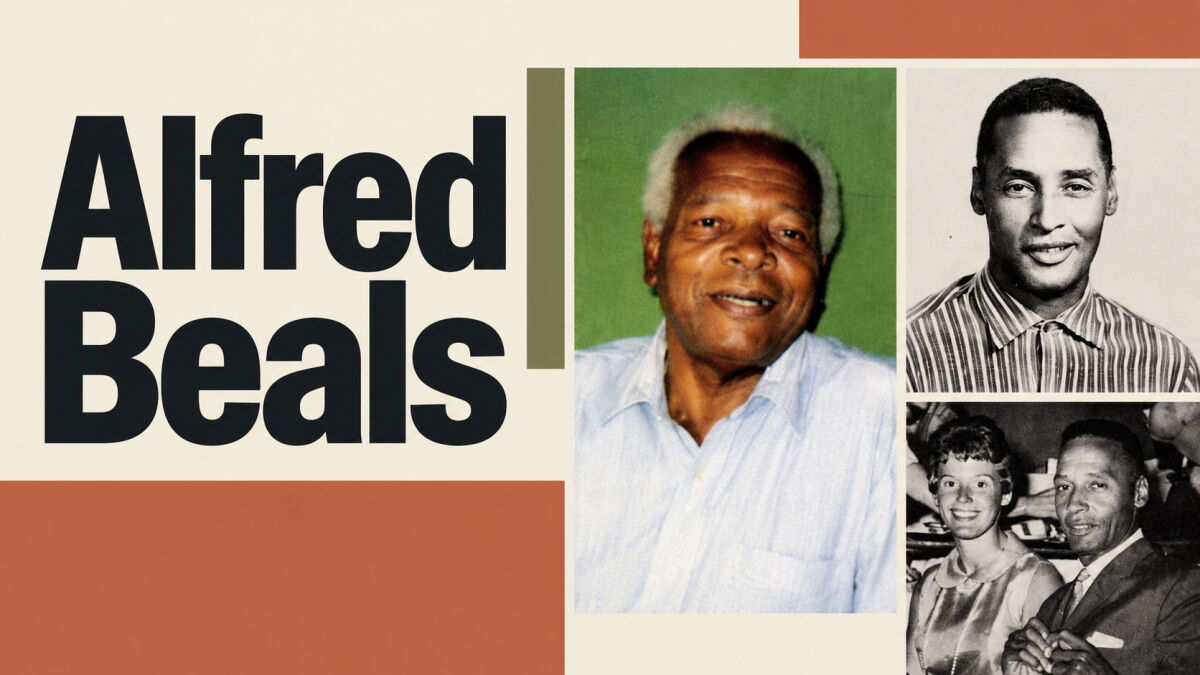
Basic Information
| Item | Details |
|---|---|
| Full Name | Alfred Leroy Washington Beals |
| Name Variants | Alfred L. Beals; Alfred Leroy Beals |
| Born | March 30, 1913 |
| Birthplace | Jasper County, Texas, USA |
| Died | December 6, 1974 |
| Place of Death | Chicago, Illinois, USA |
| Resting Place | Chicago area |
| Nationality | American |
| Ethnicity | African American |
| Occupation | Owner/operator of grocery stores (South Side of Chicago) |
| Spouse | Jeanne (née Anderson) Beals, an elementary-school teacher |
| Children | Gregory Beals (journalist/photographer); Robert “Bobby” Beals (musician); Jennifer Beals (actress) |
| Primary Residence | Chicago, Illinois (South Side) |
| Known For | Family patriarch; small-business owner; father of actress Jennifer Beals |
Roots in Texas, Life in Chicago
Alfred Leroy Washington Beals entered the world on March 30, 1913, in Jasper County, Texas—a rural expanse where families often built lives from grit and close ties. His story, however, would be indelibly linked to Chicago, the city that drew countless Americans seeking work, community, and opportunity in the mid-20th century. By the time his children were born, Alfred had planted new roots on Chicago’s South Side, a tapestry of neighborhoods where churches, corner stores, and schools stitched people together.
Those corner stores—modest, essential, and constant—were Alfred’s domain. He did not seek a spotlight; he ran a business. And yet, in neighborhoods across the South Side, the neighborhood grocer was more than a ledger and a cash drawer. He was continuity. He was the face you saw after work, the hand that stocked bread and milk, the person who knew families by name. In that sense, Alfred’s work was not just commercial; it was communal.
Groceries and Community: The Work of Everyday Stewardship
The standard sketch of Alfred’s professional life is spare but telling: owner and operator of grocery stores on Chicago’s South Side. Picture the rhythm—deliveries before dawn, aisles faced up by afternoon, a constant calculus of perishables and preferences. The work is humble but relentless. In an era before big-box dominance, small grocers were cultural centers where neighborly habits and practical necessity met.
For many families, especially in working-class and Black communities, the local grocer was a steadying presence. Alfred’s stores would have bridged suppliers and households, ensuring essentials were on the shelf and fair dealings at the counter. Day in, day out, that is how you become part of a place—through repetition, reliability, and the unheralded rituals of keeping the doors open.
Family Life and Legacy
Alfred married Jeanne Anderson, an elementary-school teacher whose classroom steadiness mirrored the constancy of her husband’s storefront. Together, they raised three children:
- Gregory, who would make his name in journalism and photography.
- Robert “Bobby,” drawn to music and performance.
- Jennifer, a daughter who would become an international figure in film and television.
Alfred died in 1974, during Jennifer’s childhood, a loss that reshaped the family’s future. Jeanne continued the daily work of parenting and teaching, and in 1981 she remarried, bringing a new chapter to a family that had already shown a deep reserve of resilience.
The legacy Alfred left is writ less in headlines than in habits: work ethic, responsibility, care for community, and pride in family. His children’s achievements—on screen, on the page, on stage—reflect a home where creativity and seriousness of purpose could coexist.
Timeline of Key Dates
| Year | Event |
|---|---|
| 1913 | Alfred Leroy Washington Beals is born in Jasper County, Texas (March 30). |
| Mid-20th century | Makes his home in Chicago; builds and runs grocery stores on the South Side. |
| 1960s | Family life in Chicago; children Gregory, Robert “Bobby,” and Jennifer grow up in the city. |
| 1963 | Birth of daughter Jennifer. |
| 1974 | Alfred dies in Chicago (December 6). |
| 1981 | Jeanne (Anderson) Beals remarries, to Edward Cohen. |
The Beals Family at a Glance
| Name | Relation to Alfred | Short Profile |
|---|---|---|
| Jeanne (Anderson) Beals | Spouse | Elementary-school teacher; raised the children in Chicago and later remarried (1981). |
| Gregory Beals | Son | Journalist and photographer; has written personal reflections on family and upbringing. |
| Robert “Bobby” Beals | Son | Musician; often mentioned as “Bobby” in family and public references. |
| Jennifer Beals | Daughter | Acclaimed actress across film and television; grew up on Chicago’s South Side. |
A Private Man in the Public Eye by Proxy
Alfred Beals never courted publicity. His public presence today tends to surface through his children’s biographies, family recollections, and memorial records—a portrait assembled from the edges inward. He does not appear as a headline subject in national papers, nor as a named executive in corporate archives, and that in itself says something: he stands for an everyday heroism that rarely gets chronicled, the steady captain of a small ship in a local harbor.
Even without detailed business filings or splashy profiles, a distinctive silhouette emerges. He was a Black small-business owner walking the tightrope of supply, cost, and customer trust in a city redefined, again and again, by neighborhood migrations and economic crosswinds. To keep a grocery running in that context took stamina, diplomacy, and a capacity to adapt. The stores—and the household they sustained—bear witness.
Context: The Neighborhood Grocer’s Role
In the decades spanning the 1950s to the early 1970s, Chicago’s South Side was a study in contrasts: formidable cultural output and strong community institutions paired with the frictions of segregation, disinvestment, and municipal neglect. The local grocer sat at a crossroads of those forces. Credit tabs whispered trust; front-window signage beckoned affordability and choice; back-room inventory decisions balanced community needs with thin margins. Owners like Alfred weren’t just merchants—they were interpreters of a neighborhood’s wants and constraints.
That role also shaped home life. Long hours were the norm. The store’s fortunes and the family’s calendar moved in lockstep. For the Beals children, the imprint is unmistakable: a model of diligence, where creativity had to coexist with responsibility, and where the community outside your door mattered.
What We Know—and What Endures
The facts are clean lines: Born in Texas in 1913. Built a life and business on Chicago’s South Side. Married to a teacher. Three children. Died in 1974. Yet the resonance of Alfred Beals’s story comes from the negative space around those lines—the everyday constancy that doesn’t show up in registries, the neighborhood relationships that don’t make it into ledgers. He was the kind of man who holds a family and a corner of a city in place without demanding credit. In that way, his legacy runs like a quiet current under the better-known accomplishments of his children.
FAQ
Who was Alfred Beals?
He was an African-American small-business owner who ran grocery stores on Chicago’s South Side and the father of three children, including actress Jennifer Beals.
When and where was he born?
He was born on March 30, 1913, in Jasper County, Texas.
When did he die, and where is he buried?
He died on December 6, 1974, in Chicago; he is memorialized in the Chicago area.
What did he do for a living?
He owned and operated grocery stores, serving neighborhood customers with everyday essentials.
Who was his spouse?
He was married to Jeanne (Anderson) Beals, an elementary-school teacher.
How many children did he have?
Three: Gregory Beals, Robert “Bobby” Beals, and Jennifer Beals.
Is there information about his net worth?
No reliable public estimates exist; he is best described as a mid-century small-business owner.
Did he appear in major news or public profiles?
He was a private individual; references to him largely appear through family biographies and memorial records.
Are there known controversies associated with him?
None are credibly documented; his public footprint reflects family and community life rather than scandal.
What is his legacy?
Work ethic, community stewardship, and a family whose achievements carry forward the values he modeled.